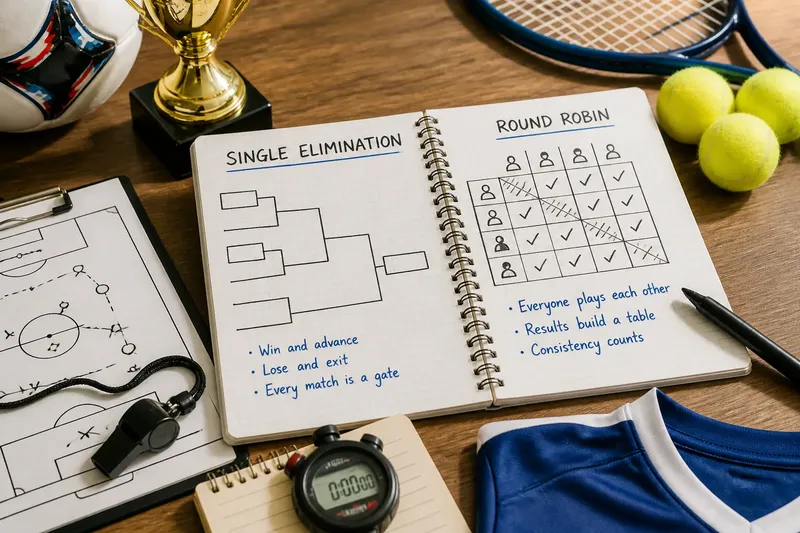
Why a Rally Can Continue After a Shot Looks Finished
Why a rally can continue after a shot looks finished: learn how boundary rules and official signals distinguish a live ball from a stoppage.

A tennis ball can seem to miss the sideline, yet a rally continues because it clipped the line. Why a rally can continue after a shot looks finished depends on the sport’s boundary rule: some decisions turn on contact or a whole-ball crossing, while others involve a separate offence and an official’s decision.
What does “out” mean in each sport?
There is no single boundary rule shared by every sport. In tennis, a ball touching a court boundary line is in. In basketball, the ball is out when it touches an out-of-bounds area or a player who is out. In football, the whole ball must pass over a touchline or goal line, whether on the ground or in the air.
These rules ask different questions. A ball that curves beyond a line in the air may return without touching anything outside; in football, that alone does not mean it is out. In tennis, the relevant moment is where the ball contacts the court.
Start by identifying the rule that applies: does it concern contact with a line, the whole ball crossing a boundary, or contact with something or someone outside the playing area? Treat any possible offence, such as offside, as a separate question.
Why can a boundary line still count as in?
Some lines form part of the playing area. In tennis, a ball touching a boundary line is in, even if most of its visible footprint appears beyond the painted edge. A spectator watching from an angle may see the ball differently from an official positioned to judge the landing.
Imagine a tennis rally in which a shot lands close to the singles sideline and clips it. The receiver stops, believing the ball missed, but the line contact means the ball is in; the rally should continue unless an authorised call stops play. The landing point matters, not the ball’s later path or the receiver’s reaction.
How do live play, stoppages and restarts differ?
In live play, the ball remains legally playable and participants are expected to continue. A stoppage interrupts play; a restart then sets out how the game resumes and who takes the next action.
Some boundary events have a direct consequence under the rules, such as awarding a throw-in after the whole ball crosses a football touchline. In other situations, an official must judge a separate issue before stopping play. A player stopping on their own does not necessarily make the ball dead.
Football offside illustrates why these decisions should not be blended. An assistant referee may delay raising a flag while judging whether a player in an offside position becomes involved in active play. The ball going out does not determine that involvement; the referee deals with the possible offside offence under the relevant rules, separately from any boundary decision.
Which boundary rule applies to your sport?
Does a tennis ball touching the line count as in?
Yes. A ball that touches a court boundary line is in, even if most of it appears beyond the painted edge. The decisive detail is contact with the line.
Can a football ball be out while it is still in the air?
Yes, if the whole ball has passed over the touchline or goal line. Its later return does not undo that crossing, though the angle can make the moment difficult to judge.
Does a whistle always mean the point or play is over?
A whistle usually marks a stoppage, but the result depends on the sport and the reason for stopping. Officials may award a point, give a free kick or arrange another restart.
Can players keep going after an assistant referee raises a flag?
In football, an assistant referee’s flag signals a possible offence, but the referee decides whether to stop play. Players should follow the referee’s decision rather than assume the flag itself has ended play.
What should you watch when a shot seems finished?
Use these checks to separate the boundary call from any separate decision:
- Check whether the sport treats the boundary line as part of the playing area; if it does, count a ball touching it as in, otherwise apply the sport’s stated boundary rule.
- In football, check whether the whole ball passed over the touchline or goal line; if it did, treat it as out, otherwise regard the boundary as not crossed.
- Check where the ball contacted the court in tennis; if it touched a line, count it as in, otherwise apply the relevant inside-or-outside court boundary.
- Check whether the ball touched an out-of-bounds area or an out-of-bounds player in basketball; if it did, treat it as out, otherwise keep tracking the play.
- Check whether an official has signalled a stoppage; if so, watch for the stated decision and restart, otherwise do not assume a player’s hesitation has ended play.
- Check for a separate offence, such as possible offside in football; if one is signalled, wait for the referee’s decision, otherwise judge the boundary event on its own.
Say you are watching football and see a cross curve close to the touchline before returning towards the pitch. First, you check whether the whole ball passed over the line; from your view, it did not, so the boundary rule alone gives no reason to call it out. Then an attacker, who had been in an offside position, moves towards the ball; that movement raises a separate question about involvement, not a new boundary test. You wait for the officials’ decision: if the referee stops play for offside, the restart follows that decision; if not, play continues. The result is clear without treating the ball’s path as proof of an offside offence.
The next time a shot looks finished, identify the sport’s boundary test first, then consider any separate offence and the official signal. That makes the reason a rally continues easier to follow, even when the ball’s path and a player’s reaction suggest otherwise.