How Racket Handle Shape and Surface Affect Your Grip
Compare racket handle shape and surface to spot pressure, slipping and awkward grip changes, then choose a design that suits your hand and playing style.
Racket handle shape and surface influence where pressure falls, how clearly you can feel the racket’s orientation and how readily your hand can change position. Those details are design choices, not finishing touches: the profile, size and grip material all affect the contact between hand and racket.
Why does handle design matter?
A handle must do more than fill the space inside your palm. Its profile gives your fingers and thumb edges or curves to meet, while its surface affects friction and feel; together, these features shape how the racket sits in your hand.
Design choices involve trade-offs. A pronounced profile may make the racket’s orientation easier to sense but press more distinctly against a finger. A softer, rounder feel may sit smoothly across the palm yet provide fewer obvious landmarks when you turn the racket.
Manufacturers also choose a base grip and handle size that can be altered with replacement grips or overgrips. That means the final feel is not determined by the bare handle alone: each added layer can change the thickness, soften edges or cover the original texture.
How should you compare racket handle shape and surface?
Start with the grips you use in your sport. Hold each racket in your usual forehand or serving position, then make the grip changes you use in play. Tennis players may shift between forehand and backhand grips; badminton players often make quick finger-led adjustments.
Look for specific contact points. Does the heel of your palm settle comfortably? Do your fingers close without bunching, and can your thumb move without being forced against an edge? Repeat the check with a relaxed hold and a firmer playing grip.
Then separate the design features rather than judging the whole handle at once:
- Profile: Notice whether the handle feels angular, rounded or contoured. If an edge presses into a finger joint, try a softer profile; if the orientation feels hard to sense, compare a more defined one.
- Thickness: Check whether your fingers meet the palm comfortably. If they overlap tightly, consider a larger grip; if they barely curl round the handle, compare a smaller one.
- Surface: Notice whether the finish feels slick, tacky, dry or rough. If your hand slips, try a more secure-feeling material; if your fingers drag during adjustments, compare a less adhesive surface.
- Seams and ridges: Check for a line or bump under a finger. If it repeatedly creates a pressure point, try a smoother wrap; if it helps you locate the handle, retain that feature in your comparison.
These are clues, not universal sizing rules. Grip style, sport and personal preference all affect what feels comfortable and workable.
What do profile and surface feel like in play?
An angular profile can make the handle’s faces easier to distinguish by touch, helping you notice a small turn in your hand. A rounder profile may feel less sharply defined and sit more smoothly across the palm. Neither shape suits every hand.
Surface feel brings its own balance. A tacky finish may feel secure, while a drier or more textured one may make repositioning easier. Raised ridges and seams can provide a useful reference point, or become irritating if they concentrate pressure in the same spot.
Notice how the surface feels during ordinary practice movements, particularly if your hand becomes damp. If the handle starts to feel slippery, compare a moisture-managing grip; if a sticky finish seems to catch your fingers, consider a less adhesive option.
How do you make a useful comparison?
Use the same sequence for each racket. If possible, compare rackets for the same sport with a similar frame setup, so differences in weight or balance do not distract from the handle.
- Hold your usual grip. Check whether the handle settles in your palm and your fingers close without strain. If they bunch or barely curl round it, compare another size.
- Turn the racket slightly. Notice whether you can feel its new orientation without looking. If it is hard to distinguish, try a more defined profile; if an edge bites into your hand, compare a rounder one.
- Change between your common grips. Check for a smooth adjustment. If the handle pinches or snags, compare a different profile or surface; if you must loosen your hold completely, reconsider the fit.
- Check the surface. Notice whether it feels slick, sticky, rough or uneven. If it slips or drags, try another finish or overgrip; if a ridge causes discomfort, look for a smoother wrap.
- Make familiar, controlled practice movements. Check whether the handle remains comfortable as your hand moves. If pressure builds at one point, identify the contact area before choosing a different profile or grip layer.
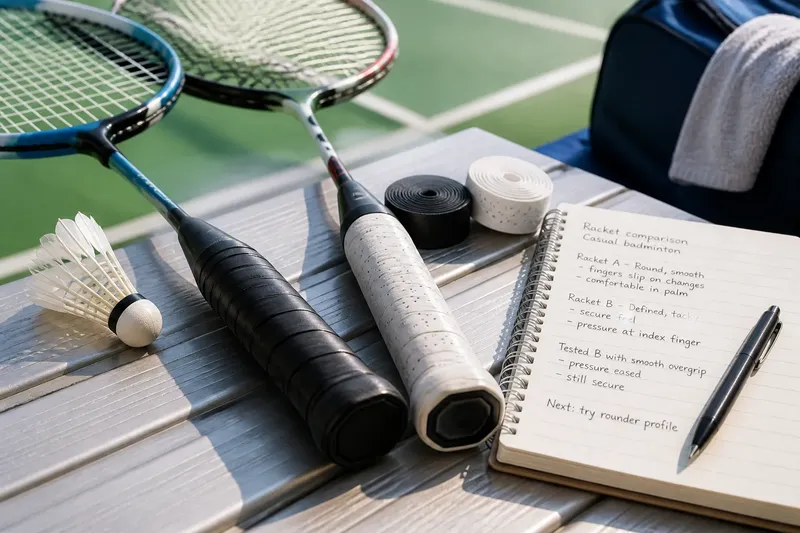
- Write down the observation. Note a detail such as “pressure at the index finger” or “easy to sense the racket face”. If the note identifies a repeatable feature, compare that feature directly; if it only says “good”, repeat the checks with more specific observations.
Say you are comparing two rackets for casual badminton. Racket A has a rounder handle and a smooth overgrip; Racket B has a more defined profile and a tackier surface. You notice your fingers slip during a relaxed grip change on A, while B feels secure but presses against your index finger. You then hold B with a smooth overgrip: if the pressure eases but the handle still feels secure, the surface and profile appear to be serving different purposes; if the pressure remains, compare a rounder profile rather than assuming tackiness is the problem.
Which handle details do players often ask about?
Does a larger handle always improve control?
No. A larger handle may feel more stable to one player, while another may find it restricts finger movement or makes grip changes clumsy. Judge the fit by how your hand closes and adjusts, not by treating size as a control rating.
Is a tacky surface better than a dry one?
That depends on the feel you prefer and how your hand responds during play. Tacky material may feel secure, while a less adhesive surface may make repositioning easier; neither quality alone determines control.
Can an overgrip alter handle shape?
Yes. Adding a layer changes effective thickness and can soften the edges of the original profile. If the handle feels crowded or indistinct, consider whether the added material is changing the fit.
Should a handle feel the same across racket sports?
No. Grip patterns and racket movements differ between tennis, badminton and other racket games. Judge the handle in the sport and grip transitions you actually use.
What can an overgrip change?
An overgrip is a replaceable layer wrapped around the handle. A thin layer may preserve more of the original profile, while a thicker one can soften its edges and make the handle feel larger.
Check the wrap before blaming the underlying handle. Overlap, wrinkles and worn patches can create bumps or slippery areas that seem like features of the racket itself; an even wrap makes it easier to judge the intended shape and surface.
Overgrips are consumable equipment. If a handle’s feel changes, inspect the layer for dirt, slickness or compression and decide whether to replace it before comparing the base design again.
How can you choose a handle that suits your hand?
Compare profile, thickness, texture and movement separately, then return to the combination that feels comfortable during your usual grip changes. Racket handle shape and surface are useful search terms, but your own notes about pressure, slipping and finger movement offer more practical clues than a broad verdict such as “comfortable”.
Handle construction and permitted modifications can vary by racket and sport. Check the manufacturer’s instructions and the rules that apply to your game before changing the grip or adding material.
Choose a design that lets you hold the racket securely without fighting the handle, while leaving room for the grip changes your game asks of you. A detail that feels minor in a stationary hold can become noticeable when your fingers need to move quickly, so include that movement in your comparison.