Reading a Championship Banner in an Empty Arena
Learn how to read a championship banner by tracing its names, dates and symbols as clues to the sporting memories a venue chooses to preserve.
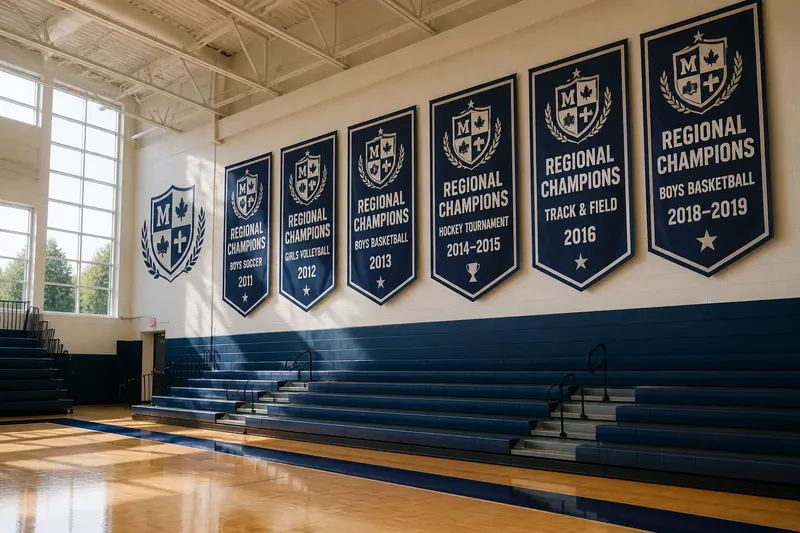
A championship banner can turn an empty arena into a place with a memory. Read its names, dates and symbols as parts of a venue’s story, not as a complete account of a season or a substitute for the result on a scoreboard.
That distinction matters. A banner is a public record, but it is also a selection: someone chose which achievement to display, how to describe it and where to hang it. The fabric tells you what a venue wants its visitors to notice first.
What does a championship banner record?
At its simplest, a championship banner identifies a team or organisation and an achievement associated with a season, competition or event. It may name a league, tournament, cup or division, then give a year or range of years. The words are usually the most direct clues, but even they need reading in context.
“Champions” could refer to a league title, a knockout competition or a tournament held at a particular venue. A banner might identify a school, club, national side or city rather than a professional team. The venue’s name and the surrounding banners can help you work out which meaning fits.
Think of the banner as a compact label attached to a larger memory. It records a claim the venue considers worth keeping visible; it does not necessarily explain the route to the title, the people involved or what happened afterwards.
How should you read the names?
Start with the most prominent name, then check whether it refers to a team, a place, a competition or a sponsor. A club name may have changed over time, while a venue name may appear in a form that is unfamiliar to a newer visitor. Treat each name as a clue to identity, not automatically as the name of the current team.
Look for smaller lettering around the main words. A division, age group, gender category or tournament title may be set below the team name, often in a less prominent position. These details narrow down what the banner is commemorating and can prevent a vague “champions” from being mistaken for a broader claim.
Names also show whose memory is being centred. A venue that displays banners for its senior teams, youth programmes and community sides is presenting a wider sporting identity than one that recognises only its top competition. Neither arrangement explains every achievement; the pattern simply shows what the venue has chosen to make visible.
What can the dates tell you?
A single year often marks the season’s ending or the year in which a title was awarded, but the convention varies between sports and organisations. A pair of years may indicate a season that crossed calendar years. When you are unsure, read the date alongside the competition name rather than treating it as self-explanatory.
Several years on one banner can represent repeated titles, separate tournament wins or a run of championships. The spacing and punctuation may suggest a sequence, but the lettering alone cannot always tell you whether the wins were consecutive. Look for words such as “consecutive” or “three-time” before inferring a continuous run.
A date is also a way to place the banner among its neighbours. If nearby banners use the same format and colour scheme, they may belong to the same display tradition. A different style could reflect a separate era, a different competition or a later decision about how to honour achievements.
Which symbols deserve a closer look?
Emblems, stars, crowns, cups, animals and geometric marks can add meaning, but their significance depends on the team and competition. A star might mark a title, form part of a club crest or simply be decorative. A cup icon may identify a competition rather than confirm that the banner depicts a particular trophy.
Begin by separating the symbol from the surrounding design. Is it repeated on the team’s badge, printed beside a competition name or used on banners from several seasons? Repetition can suggest a house style or an established emblem, while a one-off motif may refer to a particular event.
Colours deserve the same care. A familiar combination may echo a team kit or local identity, but colour alone is weak evidence: lighting, fading and fabric choices can alter how it looks from the floor. Use colour to support what the words and emblems suggest, not to settle an interpretation by itself.
How do you read a whole wall of banners?
Step back far enough to see the arrangement before focusing on individual lettering. A line grouped by team, competition or era can reveal how the venue organises its sporting memory. Banners above a particular court or rink may honour the teams most closely associated with that playing surface, while a central display may collect achievements from across the organisation.
Notice what sits together and what is separated. A venue might place league titles in one row and cup wins in another, or keep different teams in distinct sections. Those choices are part of the display’s meaning: the wall is not just a storage space for honours but an informal map of which stories belong together.
Imagine you enter a fictional school gym with a row of blue banners bearing the school crest, the words “Regional Champions” and a mix of single-year and paired-year dates. If the paired years sit beside a named tournament, you could reasonably read them as seasons associated with that event, while the crest links the entries to the school. You would still avoid calling them consecutive titles unless the banners say so or another clear clue supports it.
When a banner’s print is too high or faded to read, compare it with nearby displays and look for a programme, team noticeboard or venue history panel. Those sources may clarify a name or competition without turning your first impression into a certainty.
What questions help you interpret a banner?
Does “champion” always mean a league winner?
No. The word can refer to a cup, tournament, division or other competition, depending on the wording and the organisation. Check the event name and any category printed nearby.
Why might a banner show two years?
The competition may have run across calendar years, or the display may use a season range. Read the dates with the event title and compare the format used on neighbouring banners.
Can a symbol identify the competition?
Sometimes, especially when the same emblem appears beside a named event elsewhere in the venue. A symbol may also be part of a team crest or a decorative motif, so look for supporting words before assigning it a precise meaning.
What does an empty space in the display mean?
It may indicate a gap in the venue’s collection, a change in display policy or simply room reserved for another purpose. An empty bracket or unused hook does not, by itself, show that a team missed a title or that a banner has been removed.
Why does the display leave some stories out?
A banner wall cannot preserve every match, season or contribution. Its limits may come from available space, the organisation’s recognition policy or the practical choice to display only certain competitions. What is absent should not be treated as evidence that an achievement did not matter.
The selection can still tell you something useful about a venue’s identity. A wall dominated by one team may reflect that team’s central place in the building’s history; a varied collection may show that several programmes share the space. That is an interpretation of the display, not a verdict on the relative worth of the people or teams omitted.
If the venue provides a caption or archive reference, use it to distinguish official naming from shorthand. Where a name, emblem or date remains unclear, the staff or club history material may offer context. A careful reader can leave a question open rather than forcing a neat answer from a few stitched letters.
What is worth remembering when you leave?
Read a championship banner from the centre outward: identify the team or organisation, find the competition, place the date, then test what the symbols and arrangement add. This makes the banner more than decoration without asking it to say more than it can.
Most of all, keep the gap between an achievement and its display in view. The cloth preserves a venue’s chosen shorthand for a sporting memory; the careful reading is yours. That small pause between seeing “champions” and asking “of what, and for whom?” is what turns a glance around an empty arena into a better understanding of the place.